
Clinician Advantage
- Incremental revenue through additional procedures
- Increased patient acceptance
- Generate patient referrals
Production Efficiency
- Improved access and field-of-vision
- Decreased treatment time in many cases
- Reduced impression retakes
Patient Comfort
- Healthier approach to tissue management as compared to a scalpel or electrosurge
- Minimal need for anesthesia
- Reduction in post-op discomfort

This next-generation laser is optimized for all of your periodontal, restorative, and orthodontic procedural needs. BLU enables you to deliver the benefits of laser dentistry to each patient while increasing practice production across all departments.
- 12 user-friendly preset procedures to increase efficiency
- Lightest-weight wireless soft-tissue diode laser on the market, weighing less than a standard drill (only 1.9 oz.)
- 20 minutes of continuous operation at 1.2 watts of power, enough for more than 15 procedures before changing batteries
- Extended battery life and wireless foot pedal enable easy movement between operatories
- 2 watts of maximum power on continuous wave or pulse mode
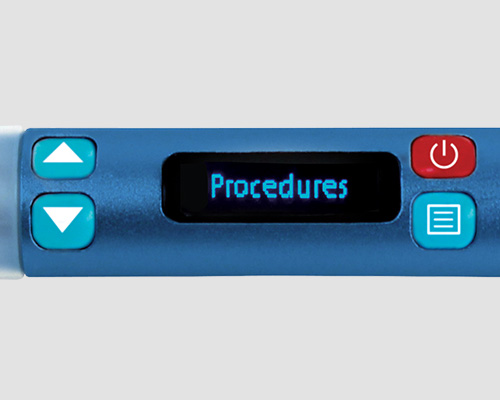
Easy-to-Use Controls
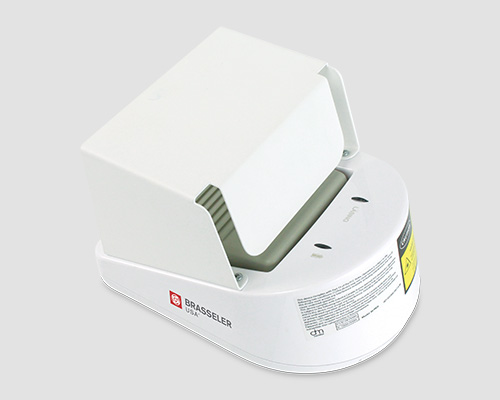
Wireless Foot Pedal with Safety Shroud
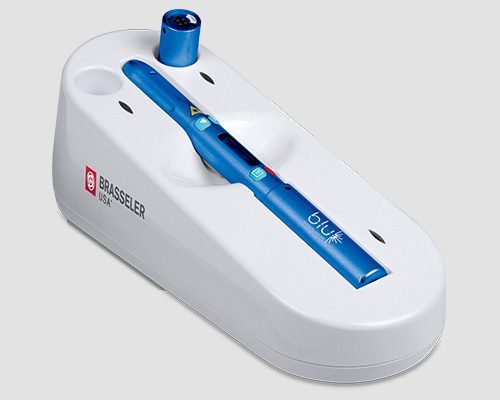
Low-Profile Base Charger
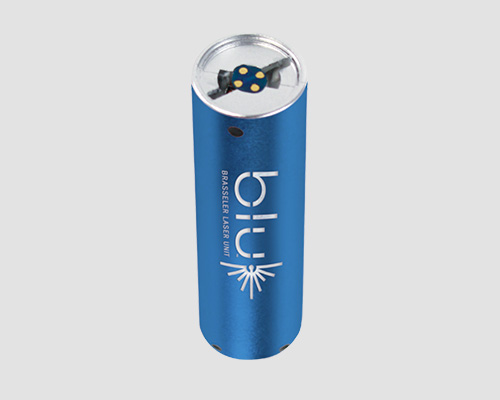
Rechargeable Lithium-ion Batteries
Compared to traditional methods and surgical devices such as electrocautery, a laser is gentler, more predictable, and often times will not require local anesthetic. Diode lasers cut with a very small zone of necrosis, allowing you to perform a wide array of soft tissue procedures with little to no discomfort, no fear of gingival recession, and rapid healing. Immediate hemostasis in most cases is another added benefit.
Laser Troughing
By using a diode laser, practitioners are able to obtain bloodless impressions with clearly exposed margins within seconds, eliminating the need to pack cord. Lasing improves visualization of prepared crown margins and aids in hemostasis so crowns and bridges are sure to fit properly every time.
Class V Restoration
Diode lasers provide the practitioner with clear and uncontaminated access to restore class V defects. The technique employs a non-surgical approach for ablation of diseased epithelium at the gingival margins and provides excellent hemorrhage control.
Recontouring
Remove excess gingival tissue easily with the use of a diode laser. Common gingival esthetic problems such as excessive gingival display or asymmetrical contours are corrected quickly and painlessly with minimal healing time.
Dental hygienists can incorporate soft-tissue diode laser therapy in combination with scaling and root planing in periodontal pockets.* A diode laser is absorbed well by melanin, hemoglobin, and other chromophores present in periodontal disease. This allows for a nonsurgical approach to gain easier access to deeper calculus deposits after ablation of diseased epithelium and hemorrhage control.
Laser-assisted periodontal therapy (LAPT) can be used as an adjunct to traditional scaling and root planing. Laser energy selectively targets only darker, necrotic tissue and leaves healthy tissue alone, allowing for better healing and results. Dental hygienists can also perform other various procedures depending on state law with a non-initiated tip such as biostimulation to aid in the healing of things like aphthous ulcers.
*Refer to State Dental/Hygiene Board for local laws.
Laser Bacterial Reduction (LBR)
Before any routine cleaning it may be warranted to use a laser to eliminate bacteria from the periodontal pocket. By using laser bacterial reduction techniques, you can prevent cross contamination in the mouth and help encourage healthy reattachment of the gum tissue.
Sulcular Debridement
A diode laser can be used to selectively remove diseased epithelium without harm to the healthy tissue, allowing the healthy tissue to regenerate. In some cases pocket depths can be reduced from <6 mm to pockets of 2-3 mm depth.
Desensitization
A thin layer of fluoride can be applied to the sensitive area, using a diode laser to perform biostimulation therapy. Occlude the varnish into the dentinal tubules to reduce dentinal sensitivity for up to 1 year.
Specialists and surgeons have unique patient needs. Some examples include short crowns which do not allow for proper bracket placement, delays in eruption of teeth, and uneven gingival margins. Unlike an Electrosurge, diode lasers are safe to use around metal brackets and implants. These techniques provide a bloodless, dry field with little to no need for local anesthesia and minimal patient discomfort.
Cuspid Exposure
A diode laser can easily remove tissue and provide instant access for bracket attachment without the need for local anesthesia. The procedure is fast and painless, resulting in a dry field that is ready for immediate bracket/button attachment, eliminating the need to wait months for passive eruption.
Operculectomy
A diode laser allows for easy removal of redundant soft tissue distal to posterior molars. The chronic recurrence of pericornitis, significant periodontal probing depths or pseudo pockets can be easily managed with this procedure.